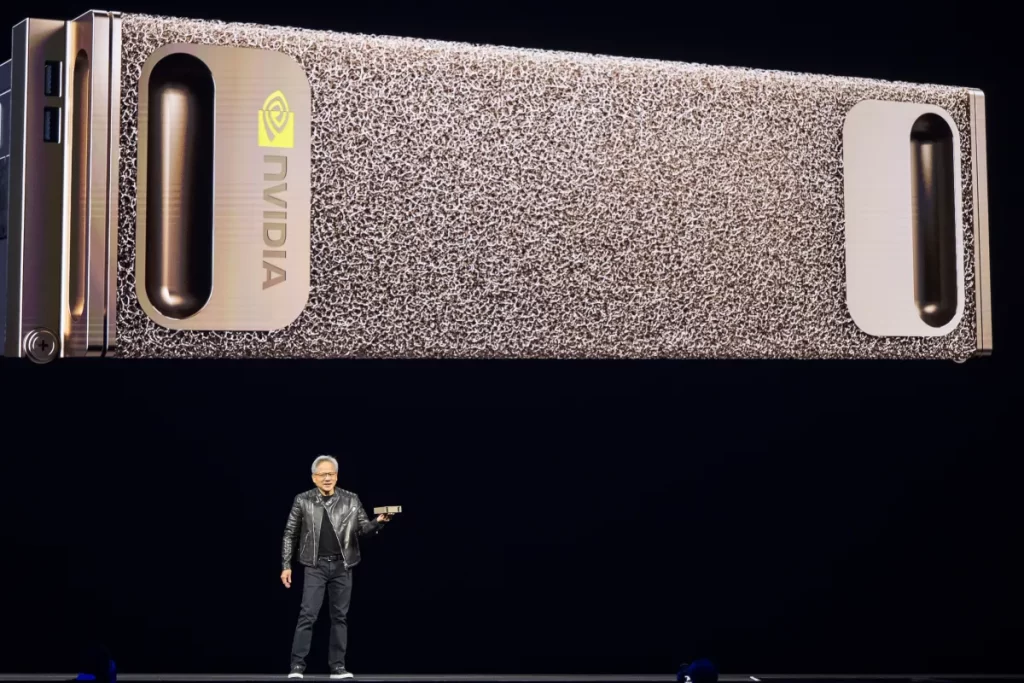
Nvidia has launched a new processor that brings advanced artificial intelligence capabilities directly onto laptops and desktop computers, escalating competition with rivals like Advanced Micro Devices (AMD), Intel, and Apple. Speaking at the Computex conference in Taiwan, Nvidia CEO Jensen Huang announced that the new RTX Spark PC chip is the fruition of a three-year collaboration with Microsoft aimed at redesigning personal computing for the AI era. Industry analysts expect the hardware to fundamentally change user interaction by executing AI agents locally on the device rather than relying exclusively on cloud data centers. Developed in partnership with Taiwan’s MediaTek, the chip marks a shift from application-heavy systems to agent-based personal computers. Industry experts draw parallels between this rollout and seminal tech milestones like the debut of the iPhone, ChatGPT, or DeepSeek, noting that localized edge AI agents will soon become a household standard.
The launch underscores Nvidia’s intensifying pivot toward consumer PCs and central processing units (CPUs). Alongside the RTX Spark, Huang highlighted the company’s new Vera CPU, which is engineered specifically to power autonomous AI agents. The $5 trillion chip giant revealed that early adopters of the Vera CPU already include prominent firms such as OpenAI, Anthropic, and SpaceX. The announcement rippled through the stock market during pre-market U.S. trading, causing shares of competitors AMD and Intel to slide nearly 4%, while Qualcomm dropped almost 7%, and Apple fell slightly by 0.6%. Conversely, Microsoft shares jumped 3.1%, lifted by a broader recovery in technology and software stocks.
The industry-wide focus on running autonomous AI agents directly on local hardware was a dominant theme leading into Computex. Qualcomm CEO Cristiano Amon echoed this sentiment, labeling 2026 as the defining year for agentic AI, where technology transitions from basic prompt-and-response applications to fully independent systems. Amon pointed out that current device architectures are built for user-initiated actions rather than always-on, autonomous agents, making a shift to local edge computing a structural necessity. For Nvidia, this architectural shift represents a significant financial opportunity; Huang previously noted that the Vera processor line unlocks a new $200 billion market segment for the company, positioned to become a primary engine for its future growth.
During his address, Huang also dismissed anxieties regarding widespread job displacement within the tech sector, labeling fears that AI would eliminate the need for software engineers as complete nonsense. He argued instead that increased productivity would actually accelerate engineering recruitment globally. Emphasizing Taiwan’s position as the core of the global AI boom, Huang announced plans to inject roughly $150 billion annually into the island’s tech ecosystem. The keynote address in Taipei follows closely on the heels of Huang’s participation in a high-profile corporate delegation that accompanied U.S. President Donald Trump to Beijing to meet with Chinese President Xi Jinping.
Click here for more on Technology