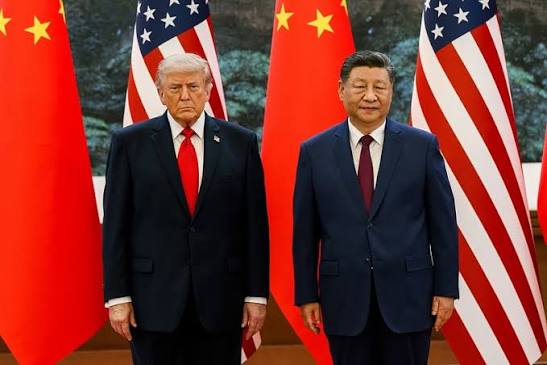
US President Donald Trump, Russian President Vladimir Putin and Chinese President Xi Jinping have issued a joint declaration outlining their commitment to peace following an unprecedented trilateral meeting in China.
The three leaders held 90-minute discussions in Shenzhen, a city in southeastern China, on the sidelines of the Asia-Pacific Economic Cooperation (APEC) summit. Although all three presidents have previously held bilateral meetings, Thursday’s gathering marked their first formal trilateral talks.
In their joint declaration, the leaders emphasised that “nuclear war cannot be won and must never be fought”, while expressing plans to increase petroleum production and supplies. They also pledged to support reforms at the United Nations to improve its ability to address international challenges.
The statement further addressed legal immunity for government officials, with the leaders agreeing that the International Criminal Court and similar institutions should not exceed their jurisdiction or misuse their authority.
Trump described the meeting as a “great and highly consequential trip” in a social media post published while returning to Washington aboard Air Force One. He also announced plans to hold a press conference at the White House on Friday to discuss the visit.
During his China trip, Trump held a separate meeting with Putin, their first encounter since August 2025, and warmly referred to the Russian president as his “friend”. He also met Xi separately, describing their relationship as “very special”.
Despite the diplomatic exchanges and positive public statements, the three leaders entered the discussions with differing priorities and political objectives. Their opening remarks offered some insight into the issues addressed during the closed-door negotiations.
Xi stressed that constructive engagement among major global powers was essential rather than optional. Putin highlighted their common interest in resolving the Ukraine conflict and indicated that food and energy security would also feature in the discussions.
China has maintained an officially neutral position since Russia launched its full-scale invasion of Ukraine in 2022. Beijing has rejected allegations from Ukraine and its Western allies that it has indirectly supported Moscow through exports of dual-use technologies with potential military applications. China has consistently called for negotiations and a political resolution while refraining from directly condemning Russia’s military actions.
Trump, meanwhile, said the leaders of three of the world’s largest countries carried a particular responsibility to maintain constructive international dialogue. He argued that previous administrations had often avoided discussions with countries holding opposing positions, adding that his approach was different.
Highlighting the three nations’ nuclear capabilities, Trump said they were in a unique position to discuss reducing the global nuclear arsenal. He also emphasised the importance of cooperation to prevent nuclear proliferation, specifically referring to Iran and reiterating that Washington would not allow Tehran to acquire nuclear weapons.
The US president also addressed the Ukraine conflict, revealing that he had already held extensive discussions with Putin. Trump expressed hope that both Russia and Ukraine would be willing to bring the war to an end.
Following the trilateral meeting, Putin described the discussions as an important milestone in diplomatic history. However, he claimed that Ukraine and European countries were not yet prepared to make the compromises necessary to resolve the conflict. He added that Moscow had invited European Union representatives to Russia to better understand their position.
Despite Putin’s public statements about pursuing peace, Kyiv came under attack from Russian drones while the summit was taking place. The Russian president has repeatedly rejected Ukrainian ceasefire proposals and continued to insist on territorial and political demands that Kyiv and its European allies consider unacceptable.
Putin also threatened a significantly stronger response to Ukrainian attacks on the bridge linking Russia with the occupied Crimean peninsula. A missile and drone strike on Tuesday had destroyed a central section of the bridge’s roadway. His remarks did not address Russia’s prolonged attacks on Ukrainian power infrastructure, bridges and residential buildings.
The Russian leader also rejected comparisons between the Shenzhen meeting and the 1945 Yalta Conference, where the Soviet Union, Britain and the United States discussed the post-Second World War international order. Putin argued that the Yalta meeting had formalised existing geopolitical realities rather than divided the world, adding that current conflicts would also need to be assessed in light of developments on the ground.
Footage released by the Kremlin showed Putin thanking Xi as he departed the summit venue, expressing surprise at how smoothly the meeting had proceeded.
China’s state broadcaster CCTV reported that Xi described the discussions with Trump and Putin as positive, constructive and productive. He also recalled the countries’ shared history of fighting during the Second World War, with the three leaders stressing the importance of protecting the peace achieved through considerable sacrifice.
The trilateral meeting was reportedly initiated by Putin and was viewed by several Russian newspapers as a diplomatic success, particularly given previous efforts by Western governments to isolate Moscow following its invasion of Ukraine.
The summit also represented Putin’s first participation in an international gathering since the beginning of the Ukraine war that included leaders from countries such as Canada, Japan and Australia.
However, Trump’s cordial engagement with Washington’s major geopolitical rivals drew criticism from US lawmakers. Republican Senator John Curtis welcomed the leaders’ recognition that nuclear war must never take place but expressed concern about the US president’s approach towards Putin and Xi.
Curtis argued that neither leader should be considered an American ally, warning that treating them as partners sharing Washington’s values and interests could undermine national security, weaken relationships with allies and create uncertainty about America’s international position.
Jeanne Shaheen, a senior Democratic member of the Senate Foreign Relations Committee, also criticised Trump’s approach, adopting a stronger tone in her response to the summit.
Click here for more on World News