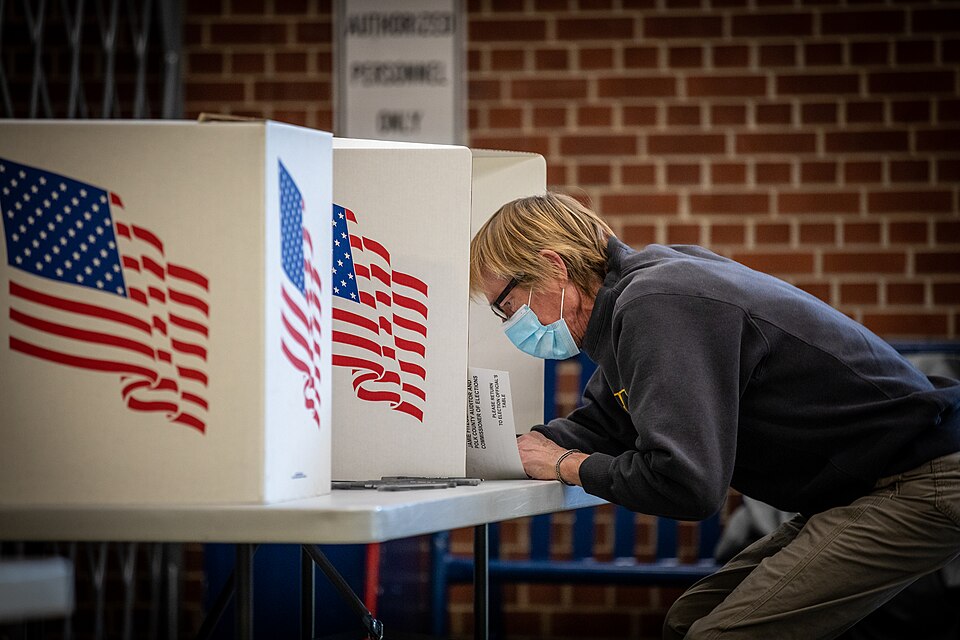
American voters are heading to the polls on Tuesday for the 2026 midterm elections, which will serve as a major assessment of President Donald Trump’s first two years in office during his second term. Opinion polls and independent political analysts largely expect Democrats to regain control of the House of Representatives, while the contest for the Senate remains highly competitive.
The Senate race is centred on nearly 10 closely contested statewide contests, most of which are taking place in traditionally Republican strongholds. Historical trends present an additional challenge for Trump’s party, as the president’s party has lost congressional seats in nearly every midterm election since World War II, with only two exceptions.
Trump’s approval ratings have fallen close to their lowest levels, reflecting growing public dissatisfaction over the conflict with Iran and the resulting increase in fuel prices. The president has remained the dominant figure in American politics throughout the campaign, repeatedly urging supporters to treat the election as a direct vote on his leadership.
Since early October, Trump has held more than two dozen campaign rallies to energise Republican supporters, mostly in states he comfortably won during the 2024 presidential election. His extensive campaign activity also highlights the challenges Republicans face in defending their congressional majorities.
Republican leaders, with Trump at the forefront, have sought to portray Democratic candidates as extreme and ideologically radical. During a speech in Washington on Monday, Trump described the Democratic candidates as the most dangerous and extreme group in the country’s political history.
However, polling suggests that voters are more concerned about the rising cost of living and remain dissatisfied with the administration’s economic policies. Trump’s sweeping tariffs and the decision to launch military action against Iran in February have contributed to increased domestic expenses. Republican candidates have also faced difficulties separating their campaigns from the president, who has consistently demanded loyalty from party members.
All 435 seats in the House of Representatives and 35 of the Senate’s 100 seats are being contested, although most races are not expected to be competitive. Democrats need to gain at least three seats in the House and four in the Senate to secure majorities in both chambers.
A Democratic victory in either chamber could significantly constrain Trump’s legislative agenda. Party leaders could initiate investigations into what they describe as conflicts of interest within the administration and use their congressional influence to demand concessions on legislation. Gaining control of the Senate would also allow Democrats to block presidential appointments, including potential Supreme Court nominations.
Despite putting Republicans under pressure in several traditionally conservative states, Democrats have limited room for error. The party must defend all its existing Senate seats while securing victories in at least two states that supported Trump by double-digit margins in 2024. These include Alaska, Iowa, Kansas, Nebraska, Ohio, South Carolina and Texas. Recent opinion polls indicate that Democratic candidates are either narrowly ahead or remain competitive in these states.
Michigan Senate race draws national attention
The Senate contest in Michigan has attracted particular attention following a surprise political endorsement. Democratic progressive candidate Abdul El-Sayed, 42, is facing Republican former US Representative Mike Rogers, 63. The race took a new turn on Sunday when Haley Stevens, who narrowly lost to El-Sayed in the Democratic primary, unexpectedly endorsed Rogers.
Beyond its implications for Senate control, the Michigan contest is emerging as an important test of whether Republican attacks focusing on candidates’ identities and political positions can influence voters in a closely divided state. El-Sayed, if elected, would become the first Muslim senator in US history.
His criticism of Israel and support for progressive policies, including universal healthcare, have also made the contest significant for the Democratic Party’s left wing ahead of the 2028 presidential election.
Alaska’s Senate race has also been surrounded by controversy following reports that the campaign of Democratic candidate Mary Peltola, 53, helped recruit a third-party candidate sharing the same first and last name as Republican incumbent Dan Sullivan, 61. Peltola has denied involvement in the matter.
Trump’s Justice Department has opened a criminal investigation into the allegations and filed a lawsuit seeking to prevent certification of the election results. However, a federal judge dismissed the lawsuit.
In Texas, Democratic candidate James Talarico, 37, has renewed hopes of securing a historic victory for his party in one of the country’s most reliably Republican states. His opponent, Republican Attorney General Ken Paxton, 63, has received substantial financial backing, including a major investment from billionaire Elon Musk, who has spent hundreds of millions of dollars supporting Republican candidates.
Kansas is another closely watched contest, where Democratic candidate Adam Hamilton, 62, a megachurch pastor, has established a narrow polling advantage over Republican Senator Roger Marshall, 66. The state backed Trump by more than 16 percentage points in 2024 and has not elected a Democratic senator in nearly 100 years.
In Maine, Republican Senator Susan Collins, 73, is seeking a sixth term in a state that traditionally favours Democrats. She faces Democratic candidate Troy Jackson, 58, a former state Senate president who secured the nomination after Graham Platner withdrew from the race following allegations of misconduct, which he denied.
Other closely contested Senate elections are taking place in Iowa, Nebraska, Ohio and South Carolina, where Republicans are defending their existing seats.
Trump administration faces scrutiny over election involvement
According to a Reuters analysis of leading election forecasters, 47 House races are considered competitive. If the remaining contests follow current projections, Democrats would need to win just 13 of those 46 closely contested races to secure a majority.
The battle for control of the House has largely centred on Republican-held districts, including several constituencies that strongly supported Trump in 2024. Republican efforts backed by the president to redraw congressional boundaries in multiple states and strengthen the party’s electoral position have so far failed to deliver the gains expected by the administration.
Democrats have also raised concerns that Trump could challenge the election results if Republicans lose control of Congress, pointing to his previous unsubstantiated claims that American elections are rigged.
The Justice Department’s involvement in election-related disputes has added another dimension to the political contest. In addition to its investigation in Alaska, the department has filed a lawsuit in California seeking to block ballots it considers potentially invalid. The move represents a departure from longstanding practices intended to limit political interference in election administration.
On Monday, the US Supreme Court rejected the administration’s request for emergency intervention in the California case.
Beyond congressional elections, voters will also decide on 36 gubernatorial contests, thousands of state legislative races and several ballot initiatives. These measures cover a wide range of issues, including proposals for billionaire taxation and abortion rights, making the midterm elections a significant test of the political landscape across the United States.
Click here for more on World News