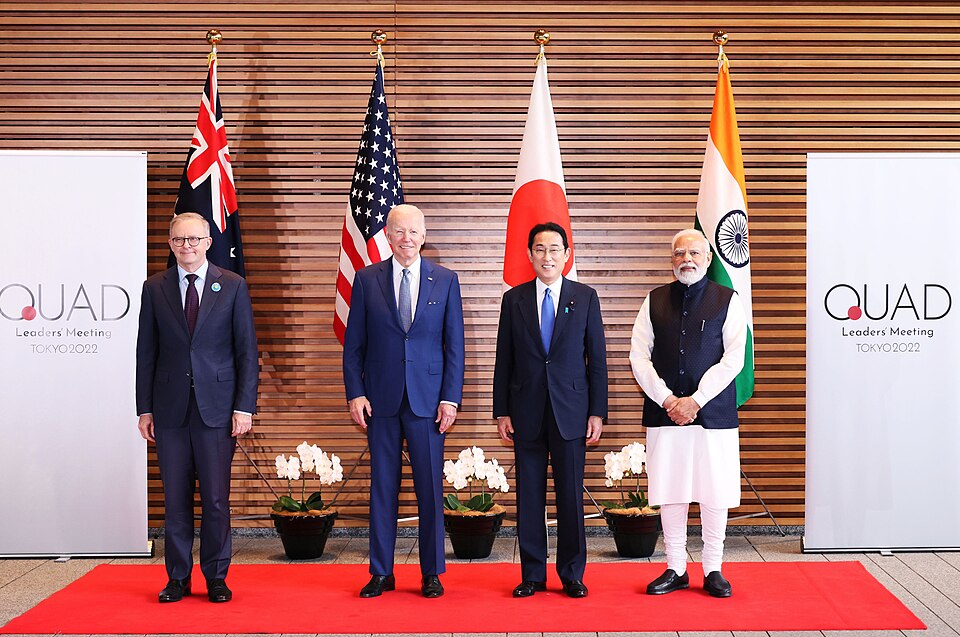
The foreign ministers of the Quadrilateral Security Dialogue—comprising Australia, India, Japan, and the United States—convened for their third meeting since September 2024, aiming to revitalize the strategic grouping. During the session, Australian Foreign Minister Penny Wong, Indian External Affairs Minister S. Jaishankar, Japanese Foreign Minister Toshimitsu Motegi, and U.S. Secretary of State Marco Rubio unveiled the Quad’s inaugural joint infrastructure project: the construction of a maritime port in Fiji designed to address capacity deficits in the Pacific Islands. Additionally, the diplomats solidified partnerships on critical minerals and regional energy security. The push follows a period of diminished momentum after the group failed to convene a leaders’ summit, a delay influenced by trade and tariff frictions between U.S. President Donald Trump and Indian Prime Minister Narendra Modi.
The newly established critical minerals framework is structured to align economic policies and coordinate investments across mining, processing, and recycling sectors to secure vulnerable supply chains. This initiative holds particular strategic value for Japan, which recently faced Chinese export restrictions on essential minerals vital to the aerospace, defense, and semiconductor industries. While the ongoing absence of a head-of-state summit has prompted analysts to question the Quad’s institutional standing, policy experts suggest that consistent delivery at the ministerial and working levels allows the alliance to maintain its regional relevance. Although New Delhi has been advocating for a state visit from President Trump to anchor a formal leaders’ summit, minister Rubio indicated that diplomatic teams are currently working to schedule a high-level meeting later this year.
Geopolitical tensions underwrote the discussions, with the ministers issuing a joint statement expressing deep concern over the militarization of disputed features in the East and South China Seas, directly referencing areas where Beijing maintains extensive territorial claims against Japan and several Southeast Asian nations. The Quad also condemned ongoing maritime attacks in the Middle East, opposing unauthorized transit tolls while advocating for uninterrupted commerce through critical chokepoints like the Strait of Hormuz and the Red Sea. In response to the summit, Beijing reiterated its criticism of the Quad, characterizing it as an exclusionary, Cold War-era bloc intended to contain China’s rise. Chinese Foreign Ministry spokesperson Mao Ning stated that regional cooperation should not target third parties or foster bloc confrontation, a diplomatic counterpoint delivered even as India navigates its own persistent border disputes with China despite recent efforts by Prime Minister Modi to stabilize bilateral ties.
Click here for more on World News