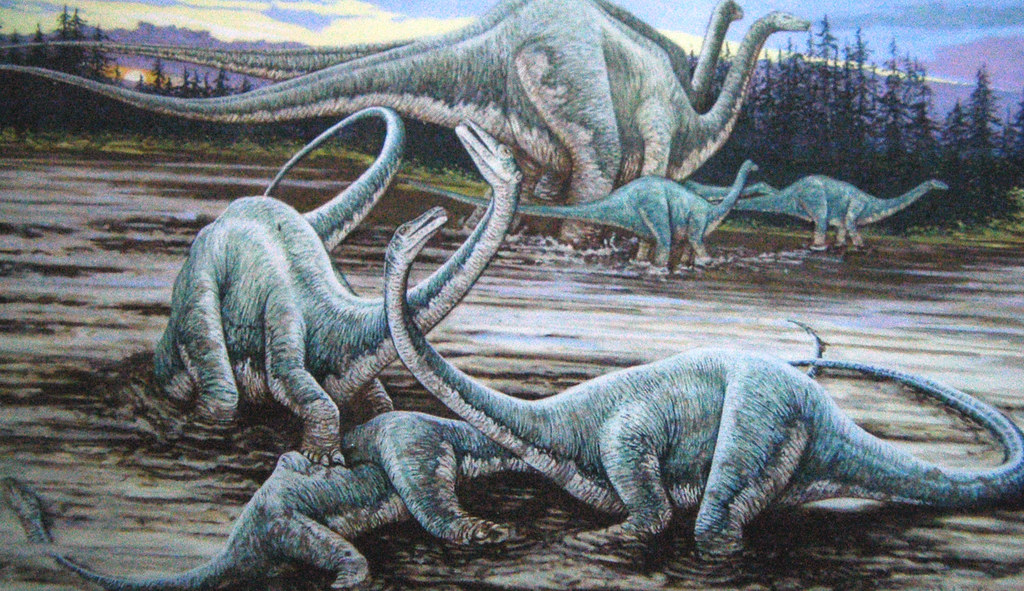
Roughly 113 million years ago during the Cretaceous Period, a plant-eating giant stretched nearly 90 feet (27 meters) long as it browsed the treetops of a warm, arid region that is now northeastern Thailand. This newly discovered species, Nagatitan chaiyaphumensis, has been identified as the largest dinosaur ever found in Southeast Asia.
According to a study published on Thursday in the journal Scientific Reports, researchers unearthed skeletal remains of the long-necked sauropod after fossils were initially spotted by a local villager in Chaiyaphum province. Over several years, paleontologists excavated the dinosaur’s spine, ribs, pelvis, and leg bones—including a massive 5.8-foot (1.78-meter) humerus. Based on the dimensions of these limbs, the research team, led by University College London doctoral student Thitiwoot Sethapanichsakul, estimated Nagatitan weighed between 25 and 28 tons. Though its head and teeth were not recovered, experts believe it was a bulk browser that consumed massive quantities of unchewed vegetation, like conifers and seed ferns, within a subtropical landscape of forests and shrublands.
At full size, Nagatitan lived with virtually no fear of predators. The ecosystem’s largest carnivore—a relative of the African Carcharodontosaurus—measured about 26 feet (8 meters) long and weighed 3.5 tons, making it completely dwarfed by the sauropod. Co-author Paul Upchurch noted that sauropods grew rapidly after hatching specifically to escape the threat of predation, as healthy, fully grown adults were far too dangerous to attack. While Nagatitan was a heavyweight by any standard, it did not quite reach the scale of South American giants like Argentinosaurus, which surpassed 100 feet in length.
Named after the Naga, a mythical serpent in Asian religious traditions, Nagatitan belongs to a sauropod subgroup characterized by lightweight, air-sac-filled bones. This group eventually became the only surviving sauropod lineage on Earth until the asteroid impact 66 million years ago. Researchers highlight that Nagatitan is the youngest and largest sauropod ever found in Southeast Asia, earning it the title of the region’s last “titan” before the area shifted into a shallow sea later in the Cretaceous. Furthermore, its existence coincides with a period of rising atmospheric carbon dioxide and climbing global temperatures, offering crucial insights into how intense climate conditions may have influenced the evolution of Earth’s largest land herbivores.
Click here for more on Lifestyle