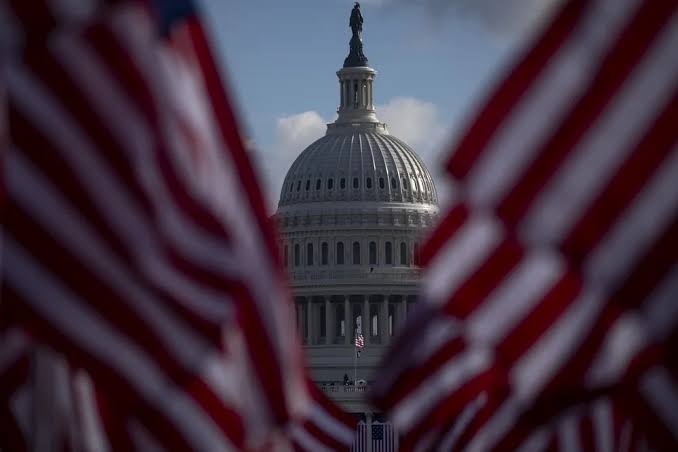
Democrats secured control of both the US Senate and House of Representatives on Tuesday, delivering sweeping victories in traditionally Republican strongholds and marking a major political setback for President Donald Trump. Millions of voters turned against the president in what emerged as a strong rebuke of his administration.
Several conservative states that had supported Trump’s return to the White House two years ago shifted significantly towards Democrats. The change was driven by growing dissatisfaction with the war involving Iran, concerns over the rising cost of living and criticism of Trump’s handling of national affairs. In Texas, the country’s largest Republican state, Democrats ended decades of electoral setbacks by winning a Senate seat and defeating three-term Governor Greg Abbott.
Kansas elected its first Democratic senator since the Great Depression, nearly a century ago. In South Carolina, where Trump secured a victory margin of almost 18 percentage points in 2024, Democrats also defeated the Senate candidate backed by the president.
The results are expected to usher in a period of divided government in Washington, following two years during which the Republican-controlled Congress largely refrained from using its authority to challenge Trump’s decisions.
When the new Congress takes office in January, Democrats are expected to intensify investigations into the Trump administration, his family and political allies, while seeking concessions on major legislative proposals. The Democratic-controlled Senate will also have the power to block presidential nominations, including appointments to the US Supreme Court if a vacancy emerges.
Senate Democratic leader Chuck Schumer described the results as a generational shift in the electoral landscape, saying voters had demanded change and that Democrats now had a responsibility to deliver.
Trump, who is constitutionally barred from pursuing a third presidential term, has maintained considerable influence over the Republican Party for nearly a decade. However, the new political balance in Washington could weaken his influence as his presidency moves towards its final years and attention increasingly shifts to the 2028 presidential election. Potential successors are also expected to compete for influence within a Republican Party preparing for a post-Trump era.
Despite concerns among Democrats that Trump might challenge the election results, as he did in 2020, the president accepted the outcome and congratulated the opposition in an interview with Fox News. He also indicated a willingness to cooperate with Democrats on issues such as immigration, although he warned that he would veto legislation he considered unreasonable.
Democratic gains reshape political landscape
Democrats centred their election campaigns on corruption and affordability, arguing that Trump’s tariff policies and the conflict with Iran had contributed to higher living costs. They also highlighted the billions of dollars reportedly earned by the president’s family since his return to the White House.
Republicans, led by Trump, focused heavily on cultural issues, including transgender rights, while portraying Democratic candidates as radical and extreme. However, opinion polls repeatedly indicated that economic concerns and household expenses remained more important to voters.
The Democratic gains extended across much of the country. According to vote tallies compiled by Reuters and USA Today, Republicans lost ground in all but a small number of the approximately 2,100 counties where most ballots had been counted.
Democrats made advances in both wealthy and economically disadvantaged counties, as well as areas with varying levels of educational attainment. Their gains were particularly pronounced in heavily Latino communities, including Texas border counties that had shifted towards Trump in 2024 and agricultural communities across Kansas.
In Seward County, Kansas, which is home to one of the country’s largest beef-processing facilities and has a Hispanic population accounting for approximately half of eligible voters, Democrat Adam Hamilton led Republican incumbent Senator Roger Marshall by 13 percentage points. This marked a sharp reversal from 2024, when Trump carried the county by 39 points.
Democrats also flipped more than two dozen Republican-held House seats, securing a majority in the chamber. They won all the closely contested House races decided so far, alongside approximately a dozen contests in districts that Trump had carried by double-digit margins two years earlier.
An unprecedented Republican effort to redraw several congressional districts to improve the party’s electoral prospects largely failed, with Democrats retaining most of the seats targeted by the redistricting initiative.
Midterm elections are traditionally viewed as a public assessment of the sitting president’s performance, and Trump actively reinforced that perception during the campaign. In the final weeks before voting, he held dozens of rallies and repeatedly urged supporters to treat the elections as though his name appeared on the ballot.
The president had also intervened in several Republican primary contests earlier in the year to secure nominations for his preferred candidates, despite concerns within the party about their political vulnerabilities.
In Texas, Trump supported state Attorney General Ken Paxton over incumbent Senator John Cornyn. In South Carolina, he backed Darline Graham, who entered politics without prior electoral experience, following the sudden death of her brother, Senator Lindsey Graham, earlier in the year. Both candidates were defeated.
Even Republican candidates who attempted to distance themselves from Trump struggled to avoid voter dissatisfaction. In Maine, incumbent Senator Susan Collins lost her re-election bid, bringing her 30-year Senate career to an end despite highlighting her willingness to disagree with the president.
In Michigan, progressive Democrat Abdul El-Sayed won the open Senate seat, becoming the first Muslim elected to the chamber. He defeated former congressman and FBI agent Mike Rogers, who had Trump’s endorsement and faced criticism for falsely portraying El-Sayed, an Egyptian American born in Michigan, as a religious extremist.
Addressing supporters after his victory, El-Sayed said Michigan had chosen hope over hate.
Meanwhile, closely contested Senate races in Mississippi and Alaska remained undecided early Wednesday.
As the scale of Republican losses became increasingly apparent on Tuesday night, Trump took to social media to argue that his absence from the ballot had prevented the party from securing a decisive victory. In subsequent media interviews, he acknowledged that the conflict with Iran had contributed to the Republican losses but defended his decision to enter the war.
Voters deliver a message to Trump
Exit polls conducted by SSRS on behalf of a consortium of US media organisations, including major television networks and the Associated Press, indicated widespread dissatisfaction with the country’s political direction.
Around half of voters nationwide said they viewed the 2026 midterm elections as an opportunity to express opposition to Trump. Approximately three-quarters said they were either angry or dissatisfied with the direction in which the country was heading.
Furthermore, 70% of respondents said they wanted Congress to exercise stronger oversight and provide additional checks and balances on presidential authority.
Democratic Senator Jon Ossoff of Georgia described the party’s victories as a decisive rejection of Trump’s leadership, citing concerns over corruption and the administration’s performance.
The election also produced several historic milestones for both parties. In Georgia, Democrat Keisha Lance Bottoms became the first Black woman elected governor of a US state. Republican Byron Donalds won Florida’s gubernatorial race, becoming the first Black Republican to hold the state’s governorship.
Democrat Gina Hinojosa is set to become Texas’s first Latina governor, while Xavier Becerra will make history as California’s first Latino governor.