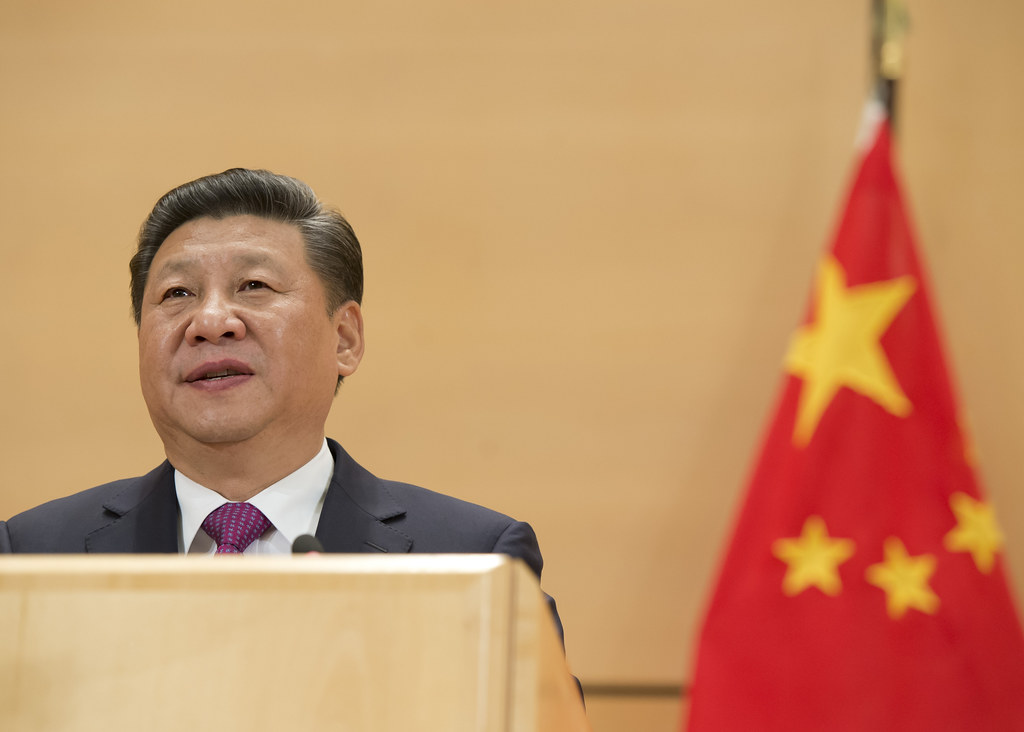
Chinese President Xi Jinping on Thursday reiterated Beijing’s commitment to achieving peaceful reunification with Taiwan, declaring that the course of history was irreversible. His remarks avoided any direct reference to military force but prompted a strong rejection from Taiwan’s government.
China considers democratically governed Taiwan part of its territory, a position firmly rejected by Taipei. Beijing has repeatedly proposed a “one country, two systems” framework for the island, an arrangement opposed by all major political parties in Taiwan.
Addressing an event at Beijing’s Great Hall of the People, Xi described resolving the Taiwan issue as an enduring historical responsibility of the Chinese Communist Party.
“The tide of history cannot be stopped,” Xi said, adding that China’s complete reunification was inevitable and would ultimately be achieved.
Taiwan’s government dismissed the statement, with its Mainland Affairs Council saying neither the administration nor the Taiwanese public would accept the “one country, two systems” proposal, which it argued would place the island under the authoritarian control of the Chinese Communist Party.
Council spokesperson Liang Wen-chieh told reporters that Xi’s latest comments on reunification largely repeated Beijing’s established position.
Xi made the remarks during commemorations marking the 160th birth anniversary of revolutionary leader Sun Yat-sen, who played a key role in the 1911 revolution that ended centuries of imperial rule in China and led to the establishment of the Republic of China.
Reaffirming Beijing’s longstanding position, Xi said China remained committed to peaceful reunification under the “one country, two systems” framework and was open to dialogue with Taiwan based on the one-China principle, which maintains that both sides of the Taiwan Strait belong to a single country.
He also called on Chinese people, including those living in Taiwan, to unite against pro-independence movements and work towards peaceful development of cross-Strait relations.
Although Xi did not refer to the possible use of force, Beijing has never ruled out military action to bring Taiwan under its control. Chinese military forces continue to operate around the island regularly, while expanding their presence further into the Pacific region.
Taiwan’s defence ministry said it had identified 29 Chinese military aircraft, including J-16 fighter jets and drones, operating around the island alongside Chinese naval vessels in what Beijing described as a joint combat readiness patrol beginning on Thursday.
TAIWAN WARNS CITIZENS AGAINST PARTICIPATING IN CHINESE EVENTS
Xi’s remarks came a week before the Asia-Pacific Economic Cooperation (APEC) summit in Shenzhen, China’s southern technology hub, where he is expected to meet US President Donald Trump again. The speech also preceded important local elections in Taiwan scheduled for later this month.
Last month, Taiwan’s government urged its citizens to avoid events organised by China to commemorate Sun Yat-sen’s anniversary, accusing Beijing of misrepresenting his political legacy and historical significance.
China regards Sun as a prominent national hero and patriot, as well as an important precursor to the communist revolution of 1949, which forced the defeated Republic of China government to relocate to Taiwan.
Xi described Sun as a national hero, a devoted patriot and an influential pioneer of China’s democratic revolution. He also highlighted Sun’s commitment to national unity and opposition to movements seeking to divide the country.
SUN YAT-SEN’S LEGACY REMAINS A POINT OF CONTENTION
In Taiwan, Sun is officially recognised as the “father of the nation”, and his portrait remains displayed in the presidential office. However, his political philosophy, known as the “Three Principles of the People”, is no longer a compulsory part of the school curriculum.
Taiwanese President Lai Ching-te and his ruling Democratic Progressive Party (DPP) continue to emphasise the island’s distinct identity and autonomy from China. At the same time, they have adopted a stronger position on protecting the historical legacy of the Republic of China.
Relations have become particularly strained over Beijing’s attempts to claim a central role in China’s victory during World War Two. Taiwan maintains that it was the Republic of China government that fought alongside the Allied powers, noting that the People’s Republic of China was not established until 1949.
Beijing has repeatedly labelled Lai a separatist and refused to engage in direct dialogue with his administration. Lai, meanwhile, maintains that Taiwan’s future must be determined solely by its people.
Click here for more on World News