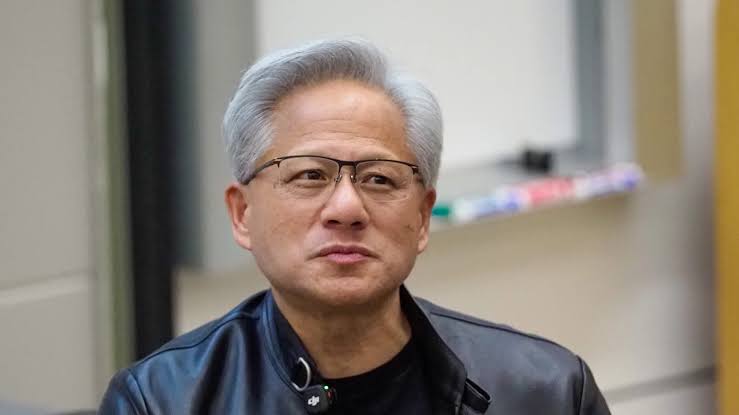
Nvidia CEO Jensen Huang is stepping down from his position, marking a major leadership shake-up for the artificial intelligence industry and raising questions about the future direction of the chipmaker he transformed into a global AI powerhouse.
Chief Financial Officer Colette Kress will serve as interim CEO while the company searches for a permanent successor, Nvidia announced on Thursday. The company has also appointed former Synopsys CEO and board member Harvey Jones as its first-ever chairman.
Huang, who co-founded Nvidia and holds approximately 3.61% of its shares, making him the company’s fourth-largest investor, will also step down from the board.
Nvidia shares dropped more than 10% in premarket trading, contributing to broader market weakness.
Mounting pressure had surrounded Huang in recent days following reports alleging that the 63-year-old had an affair with a Chinese businesswoman whom US authorities reportedly suspect of having links to Chinese intelligence. Earlier reports also alleged that he had a relationship with a senior Nvidia executive who directly reported to him.
According to a person familiar with the matter, Nvidia’s board convened on Wednesday to discuss Huang’s potential removal following the emergence of the allegations.
His departure leaves the $4 trillion company facing considerable uncertainty and could have significant implications for the wider AI industry. Huang played a central role in building Nvidia’s AI ecosystem by reinvesting the company’s growing financial resources into cloud service providers, suppliers and major AI research laboratories.
Michael Feldman, portfolio manager at ClearBridge Investments, said Nvidia’s immediate challenge would not necessarily be its technology roadmap, which remains largely established for the coming years, but the ability to maintain effective execution. He noted that Huang had been instrumental in coordinating an increasingly complex business ecosystem, making his leadership a significant competitive advantage.
The leadership change comes at a time when investor confidence in AI-related stocks is already facing challenges. Increasing capital expenditure, substantial cash consumption and rising debt among major technology companies have raised concerns about the long-term financial returns of the AI boom.
Huang’s exit could also influence US semiconductor export policy, particularly given his efforts to maintain Nvidia’s access to the Chinese market and his relationship with US President Donald Trump.
Trump said on Sunday that Huang had made an outstanding contribution to the country. He also claimed that the Nvidia chief had told him he was unaware that the Chinese businesswoman involved in the alleged relationship was suspected of being a spy.
HUANG’S CELEBRITY STATUS IN THE TECHNOLOGY INDUSTRY
Nvidia was once primarily recognised for producing high-performance graphics processors used by gaming enthusiasts. However, its chips’ ability to handle large volumes of parallel computing tasks has made them essential to the development of artificial intelligence. This technological advantage transformed Nvidia into a critical player in the global AI race and helped it become the world’s most valuable company.
The company’s success also elevated Huang into one of the technology industry’s most recognisable executives. His appearances frequently attract enthusiastic crowds, particularly in Taiwan and South Korea, where admirers seek autographs on books, posters and even personal belongings. His public comments about companies have also been known to influence investor interest and stock movements.
However, attention has increasingly shifted towards allegations surrounding his personal relationships. Reports have linked Huang to Alice Huang, a former executive at Singapore-based cloud computing company Megaspeed, whom US authorities have reportedly identified as an alleged Chinese intelligence asset. The two individuals, who are not related, have been photographed together at various locations, including Taiwan, Singapore and California.
Megaspeed has also attracted scrutiny from US authorities over suspicions that it may have helped China access advanced AI chips restricted under American export controls. The company was reportedly an important Nvidia cloud partner with priority access to its processors. Beijing has denied allegations that Alice Huang was involved in espionage.
Earlier this month, Nvidia’s board initiated an investigation, overseen by independent directors and external legal advisers, into whether Huang had been targeted by a foreign intelligence operation. At the time, the board publicly expressed confidence in his leadership.
The controversy intensified on Wednesday after a New York Times report alleged that Huang had also been involved in an extramarital relationship with Kimberly Powell, Nvidia’s vice president of healthcare, who reported directly to him.
Click here for more on Technology