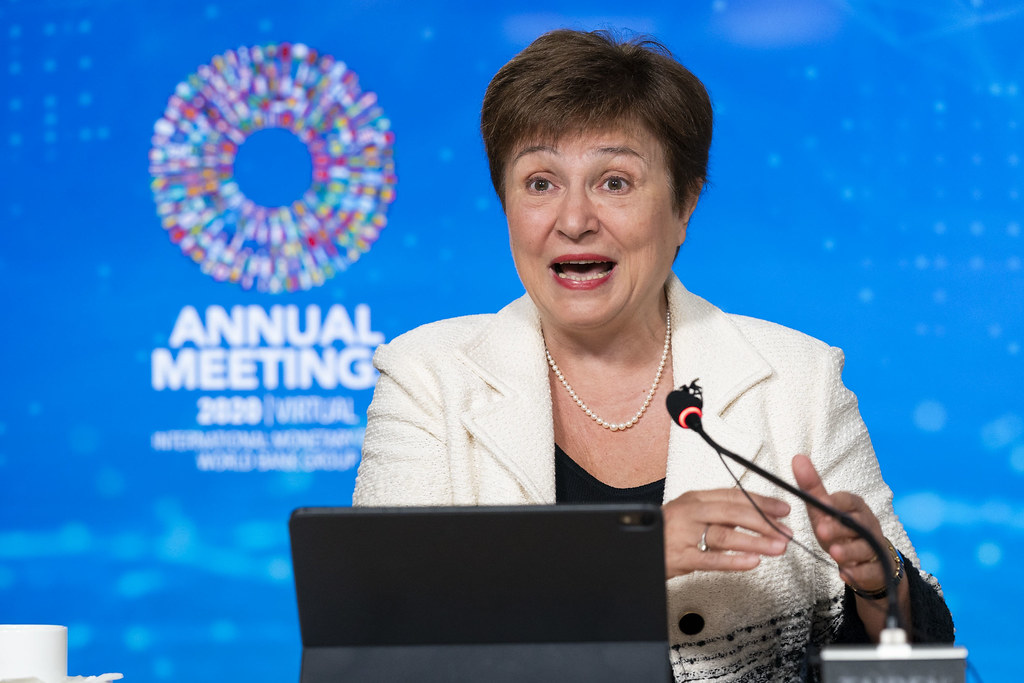
The head of the International Monetary Fund issued a stark warning on Monday, noting that global inflation is already accelerating and could lead to a “much worse outcome” if Middle Eastern hostilities persist into 2027. IMF Managing Director Kristalina Georgieva stated that the organization’s original “reference scenario”—which anticipated a brief conflict with manageable growth and price shifts—is no longer a viable outlook. As the war continues, she noted that the global economy has already shifted into an “adverse scenario” characterized by oil prices hovering near or above $100 per barrel.
During a Milken Institute conference, Georgieva emphasized that while long-term inflation expectations are currently stable, a prolonged conflict pushing oil toward $125 per barrel would inevitably cause these expectations to “de-anchor.” According to the IMF’s latest modeling, this “severe scenario” could see global growth plummet to just 2% while headline inflation climbs to 5.8%. Georgieva cautioned that many policymakers are still reacting as if the crisis is temporary, warning that subsidies and measures designed to protect consumers are keeping oil demand dangerously high despite shrinking supplies.
The physical reality of the crisis was echoed by Chevron CEO Mike Wirth, who joined the panel to discuss the impact of the Strait of Hormuz closure. With roughly 20% of the world’s crude supply previously passing through the waterway, Wirth predicted that physical shortages are imminent. He warned that Asian economies would likely be the first to shrink as markets are forced to adjust to the supply vacuum caused by the U.S.-Israeli conflict with Iran.
Beyond energy, the IMF is tracking a slow-moving but severe disruption to global supply chains. Georgieva highlighted that fertilizer costs have already surged by 30% to 40%, a spike that is expected to drive global food prices up by as much as 6%. Urging a shift in fiscal policy, she advised governments to avoid “throwing gasoline on the fire” by artificially stimulating demand while global supply continues to contract.
Click here for more on Finance and Investing